








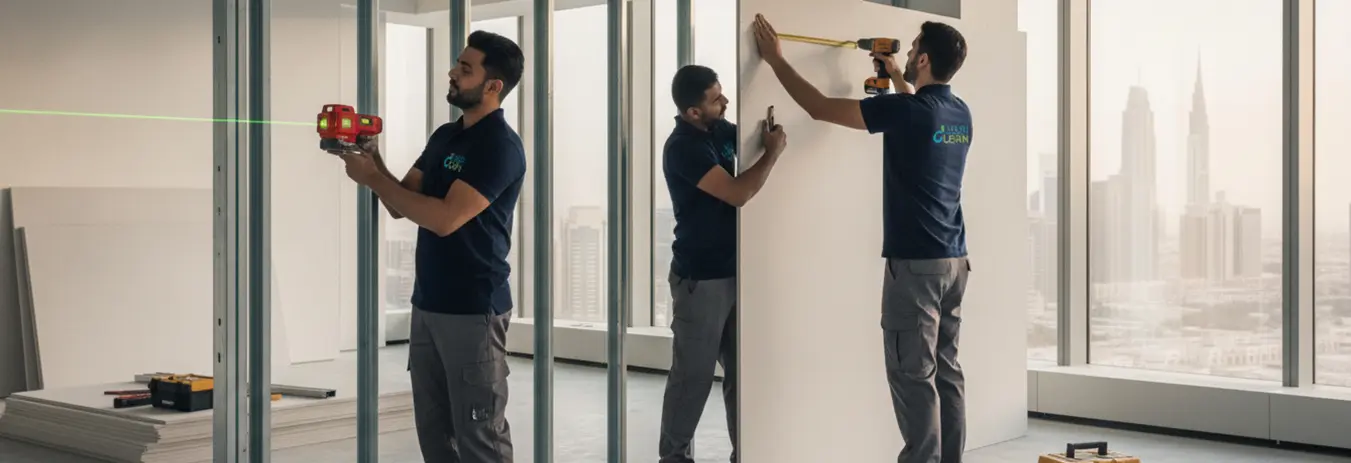

Gypsum Board Partition is widely used in Dubai properties for creating flexible interior spaces in homes, offices, and commercial buildings. If you're wondering how to install gypsum board partition, understanding the right installation process is essential for achieving durable and professional results. It is a lightweight and cost-effective solution that allows fast space division without heavy construction work. This guide explains the complete installation process, materials, thickness options, and expert tips for achieving durable results in Dubai interiors.
Gypsum Board Partition is a non-load-bearing interior wall system made using gypsum sheets fixed on a metal frame. It is commonly used in Dubai due to its quick installation, smooth finishing, and modern appearance suitable for residential and commercial spaces.
It is widely used in offices, villas, apartments, retail shops, and renovation projects where flexible space division is required without permanent brick walls.
Gypsum Board Partition offers fast installation, lightweight structure, fire-resistant options, and easy modification for future interior changes.
Gypsum Board Partition Materials include gypsum sheets, metal studs, tracks, screws, joint tape, and joint compound. These materials work together to create a strong and stable interior wall system suitable for Dubai construction standards.
Essential tools include a drill machine, measuring tape, spirit level, cutter, and screw gun for precise installation and alignment.
Gypsum Board Partition thickness varies depending on usage and building requirements in Dubai. Standard residential partitions use 75mm to 100mm thickness for normal separation and stability. Acoustic partitions use double layers with insulation for soundproofing purposes in offices and studios. Fire-rated partitions use specialized boards to meet Dubai safety regulations and building compliance standards.
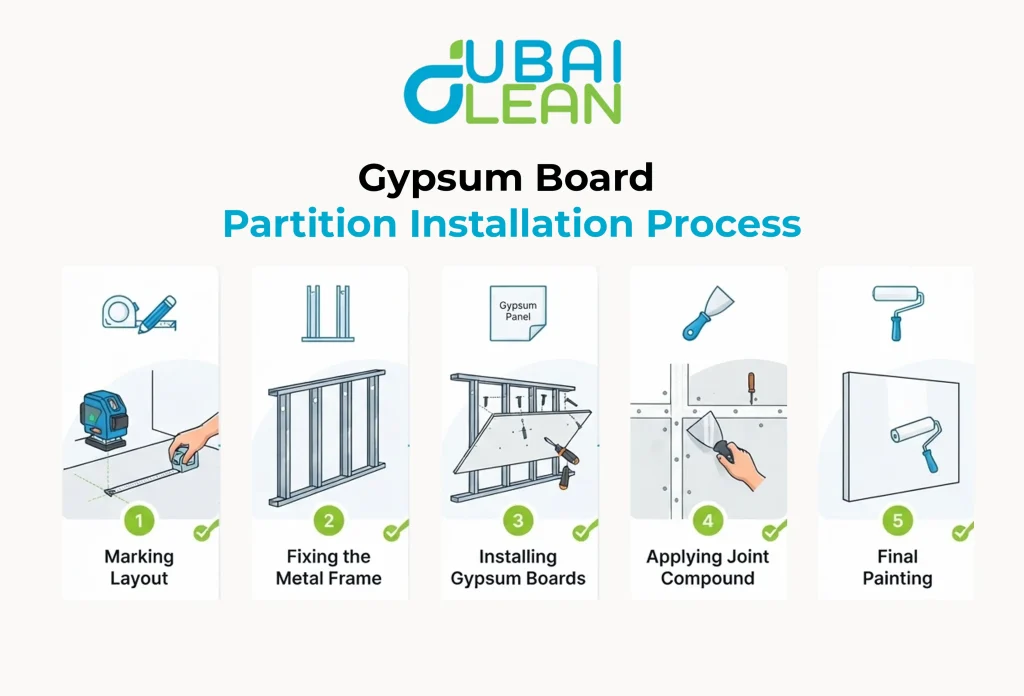
Gypsum Board Partition installation starts with accurate layout marking on the floor and ceiling to define wall positioning. Metal tracks are then fixed securely to form the frame base structure. Vertical studs are installed at equal spacing to provide stability and support for gypsum boards. Boards are then fixed on both sides using screws for a complete enclosure. Joints are sealed using tape and compound to create a smooth surface, followed by sanding and painting for final finishing.
The installation process begins by marking precise lines on both the floor and ceiling. This ensures accurate wall positioning and proper alignment before any framing work starts, helping avoid structural errors later in the project.
Metal tracks are securely fixed along the marked lines on the floor and ceiling. These tracks form the base structure of the Gypsum Board Partition and provide strong support for the vertical framing system.
Vertical studs are placed inside the metal tracks at equal spacing. This step is important for maintaining strength, stability, and proper load distribution across the entire partition frame.
Gypsum boards are attached to both sides of the metal frame using screws. This creates a complete enclosure and forms the main wall surface, ensuring durability and a clean interior finish.
All joints between boards are sealed using joint tape and compound. This process removes visible gaps and creates a smooth, seamless surface ready for final finishing work.
After drying, the surface is sanded to remove imperfections. A final coat of paint is then applied, giving the Gypsum Board Partition a clean, polished, and professional appearance suitable for Dubai interiors.
You can read the complete step-by-step informational guide on gypsum board partition installation in Dubai here: How to Install Gypsum Board Partition: Complete Expert Guide.
| Feature | Gypsum Board Partition | Brick Wall |
| Installation Time | Fast | Slow |
| Weight | Lightweight | Heavy |
| Cost | Affordable | Expensive |
| Flexibility | High | Low |
| Maintenance | Easy | Difficult |
Gypsum Board Partition is more suitable for modern Dubai interiors due to flexibility and cost efficiency.
Gypsum Board Partition cost depends on material quality, project size, and design complexity. Larger spaces require more materials and labor, while added features like doors, insulation, and fire-resistant boards increase the total installation cost. Professional installation ensures better durability and long-term performance.
Professional installation ensures accurate alignment, strong structure, and high-quality finishing. Experts follow Dubai Municipality technical guidelines and ensure proper safety standards. This results in durable partitions that perform well in both residential and commercial environments.
Gypsum Board Partition is an ideal solution for modern Dubai interiors due to its flexibility, affordability, and fast installation process. Proper use of Gypsum Board Partition Materials and correct techniques ensures durability, stability, and long-lasting performance across all property types. Correct Gypsum Board Partition thickness also improves strength and insulation. For professional results in Dubai, consider DubaiClean.
Gypsum Board Partition is used for creating lightweight interior walls in Dubai homes, offices, and commercial spaces. It allows flexible room division, fast installation, and modern interior design solutions suitable for various property types and renovation projects.
Standard Gypsum Board Partition thickness ranges from 75mm to 100mm depending on usage. Residential areas use standard thickness, while offices may use double layers with insulation for better soundproofing and stronger structural performance.
Gypsum Board Partition Materials include gypsum sheets, metal studs, screws, joint tape, and joint compound. These materials ensure stability, smooth finishing, and long-lasting performance in interior wall construction projects across Dubai properties.
Yes, a gypsum board partition is durable when installed correctly using quality materials. It offers long-term stability, requires low maintenance, and performs well in residential and commercial environments when handled with proper installation techniques.
Yes, a gypsum board partition can be made soundproof by adding insulation material and using double-layer boards. This is commonly used in offices, meeting rooms, and studios where privacy and noise control are important.